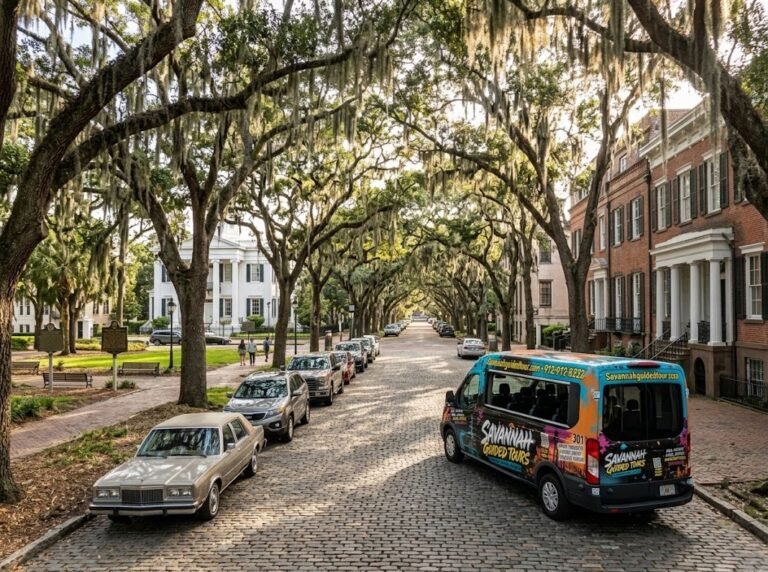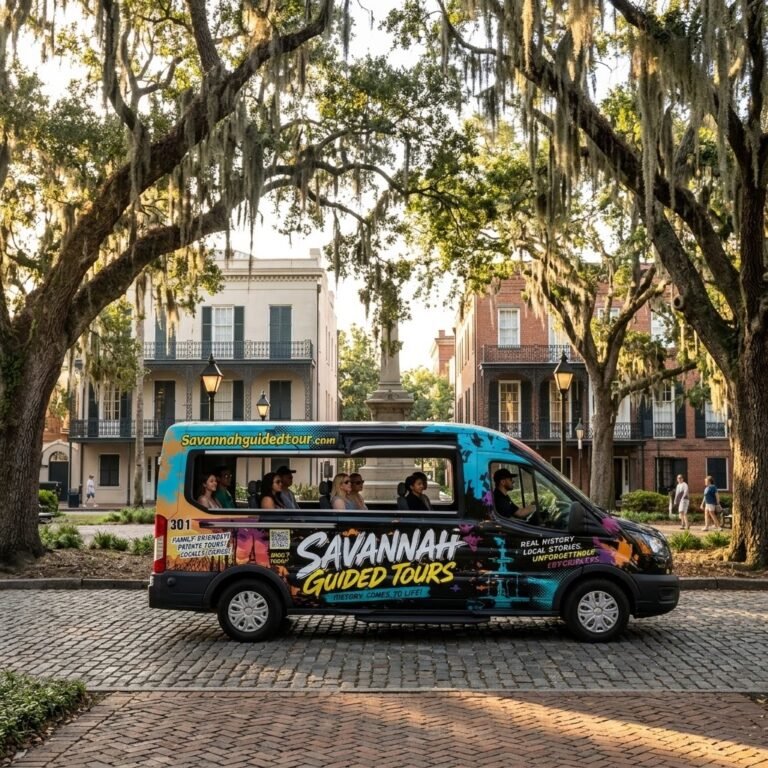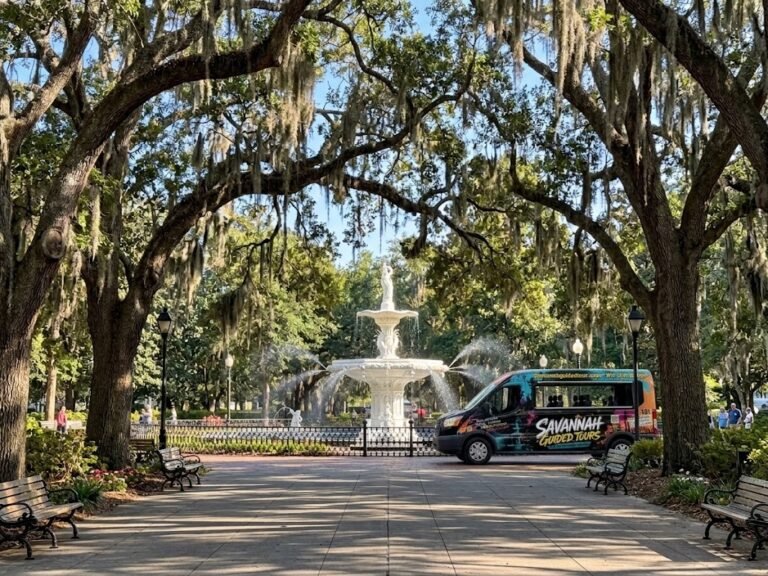
The Savannah squares are the reason the city looks the way it does. Twenty-two small parks, each shaded by live oaks and ringed by churches, houses and museums, are spread across the Historic District in a pattern that has barely changed since 1733. If you want to understand Savannah, the squares are the best place to start.
This guide explains where the squares came from, lists all 22 with what to look for in each, and shows how to see them in an afternoon on foot or in 75 minutes with a guide. It is built as a reference, so use the table to jump around.
The short history of Savannah’s squares
James Oglethorpe founded Savannah in 1733 and laid the city out on a grid. The basic unit was the ward: a public square in the center, surrounded by four residential blocks (called tithings) and four civic blocks (called trusts) reserved for churches, markets and other public uses. The first four squares were Johnson, Percival, Decker and St. James. You know them today as Johnson, Wright, Ellis and Telfair. As the city grew, new wards were added with a new square each time, and by 1851 there were 24.
In the 20th century, some of them were lost. Elbert and Liberty squares were largely destroyed by road building and are now only slivers along Montgomery Street. Ellis Square was paved over in the 1950s for a parking structure, and Franklin Square nearly disappeared in the 1970s. Both were reclaimed: Franklin Square was restored in the 1980s, and Ellis Square reopened in 2010. That is how the city arrived at 22 squares today. The full list is on the Squares of Savannah Wikipedia page.
The preservation story matters too. In 1955, a group of residents formed the Historic Savannah Foundation after the old City Market was torn down. That group helped save much of what you see now, and one of the squares below is where the movement began.
How to read the map
Orientation is simple once you know three things:
- Bull Street is the spine. Five squares sit along it, from north to south: Johnson, Wright, Chippewa, Madison and Monterey. Forsyth Park is at the southern end.
- The river is north. Bay Street and River Street run along the Savannah River on the north edge of the district.
- The grid repeats. Most squares have the same layout, so it is hard to get truly lost.
Walking from Johnson Square to Monterey Square takes about 20 minutes without stops. Seeing every square takes most of an afternoon.
Savannah’s 22 squares at a glance
| Square | Year | Known for |
|---|---|---|
| Johnson | 1733 | The first square; Nathanael Greene monument; Christ Church |
| Wright | 1733 | Tomochichi’s memorial boulder; federal courthouse |
| Ellis | 1733 | City Market; Johnny Mercer statue; restored in 2010 |
| Telfair | 1733 | Telfair Academy and the Jepson Center |
| Reynolds | 1734 | John Wesley statue; The Olde Pink House |
| Oglethorpe | 1742 | Owens-Thomas House |
| Franklin | 1790 | First African Baptist Church; Haitian monument |
| Washington | 1790 | A quiet residential square near City Market |
| Warren | 1791 | One of the smallest squares |
| Columbia | 1799 | Davenport House; the Wormsloe fountain |
| Greene | 1799 | Second African Baptist Church |
| Orleans | 1815 | A fountain honoring Savannah’s German societies |
| Chippewa | 1815 | Oglethorpe statue; Forrest Gump bench site |
| Lafayette | 1837 | Cathedral Basilica; Flannery O’Connor Childhood Home |
| Pulaski | 1837 | Shaded and quiet |
| Madison | 1837 | Sergeant Jasper monument; Green-Meldrim House |
| Crawford | 1841 | A gazebo and a neighborhood feel |
| Monterey | 1847 | Pulaski monument; Mercer House |
| Chatham | 1847 | Gordon Row; residential and calm |
| Taylor | 1851 | Wesley Monumental Church; Massie Heritage Center |
| Whitefield | 1851 | Gazebo; First Congregational Church |
| Troup | 1851 | Armillary sphere; row houses |
The squares every first-time visitor should see
Johnson Square
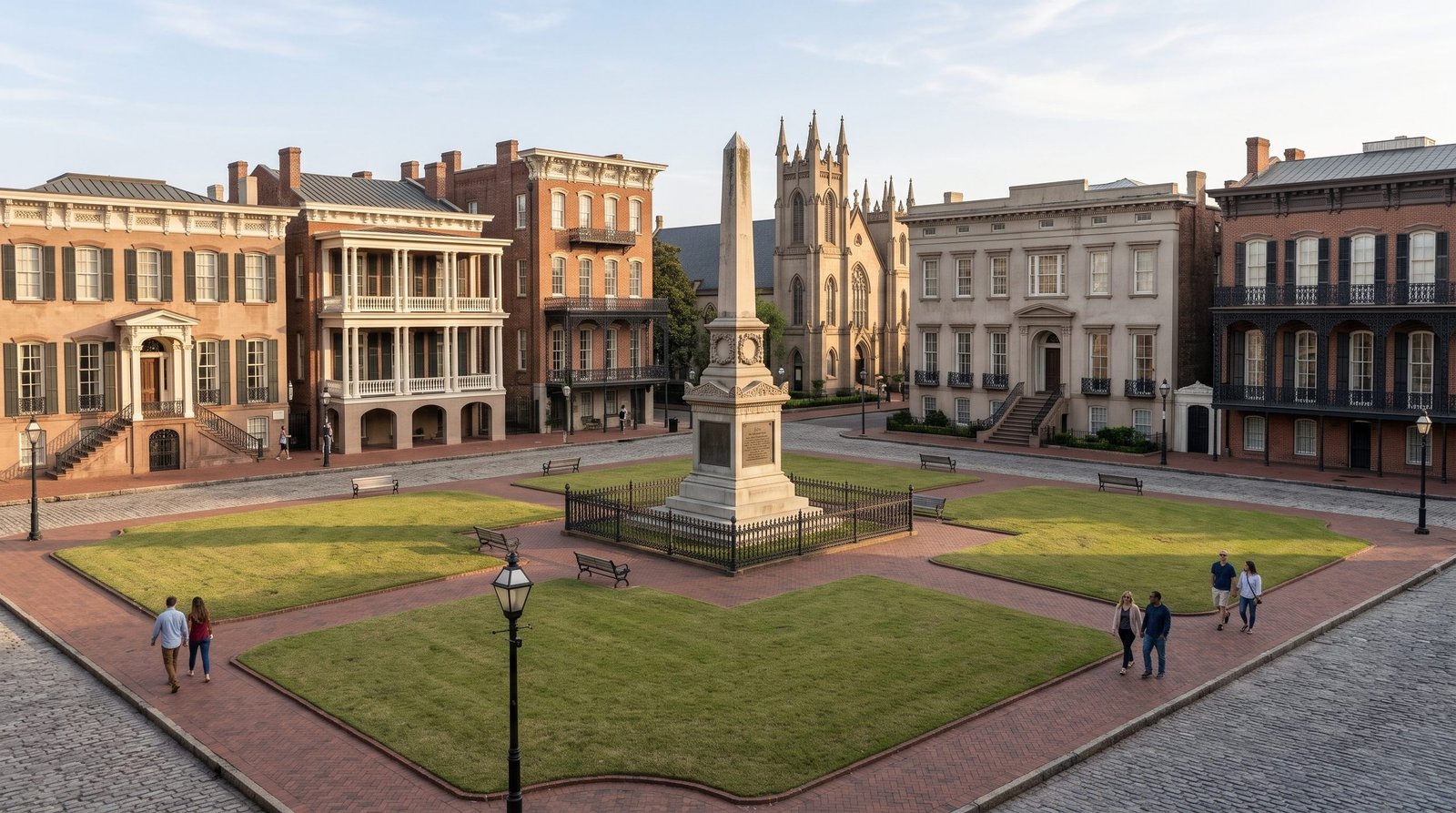
Johnson Square is the first square in Savannah and the largest of the original ones. It is named after Robert Johnson, the royal governor of South Carolina, who supported the colony. A monument in the center honors Revolutionary War general Nathanael Greene. Christ Church Savannah, founded in 1733, faces the square, and the banks and offices around it make this the commercial heart of the old city.
Wright Square
Wright Square holds a granite boulder that marks the grave of Tomochichi, the Yamacraw leader who welcomed Oglethorpe’s settlers. The boulder was placed in 1899. A monument to William Washington Gordon, the founder of the Central of Georgia Railway, stands nearby, and the federal courthouse and the Lutheran Church of the Ascension face the square. It is worth a few minutes to read the markers.
Chippewa Square
Chippewa Square is the one most visitors know from film. The bench scenes in Forrest Gump were shot here, though the bench was a prop and now sits in the Savannah History Museum. A bronze statue of James Oglethorpe stands in the center, and the Savannah Theatre and First Baptist Church line the edges. Our post on where the Forrest Gump bench is now has the full story.
Madison Square
Madison Square honors Sergeant William Jasper, a hero of the 1779 Siege of Savannah. The Green-Meldrim House on the square served as General William T. Sherman’s headquarters when he captured the city in December 1864, and St. John’s Episcopal Church and the Sorrel-Weed House face the square too. SCAD’s Poetter Hall is nearby, which gives the area a lively, youthful feel on weekdays.
Monterey Square
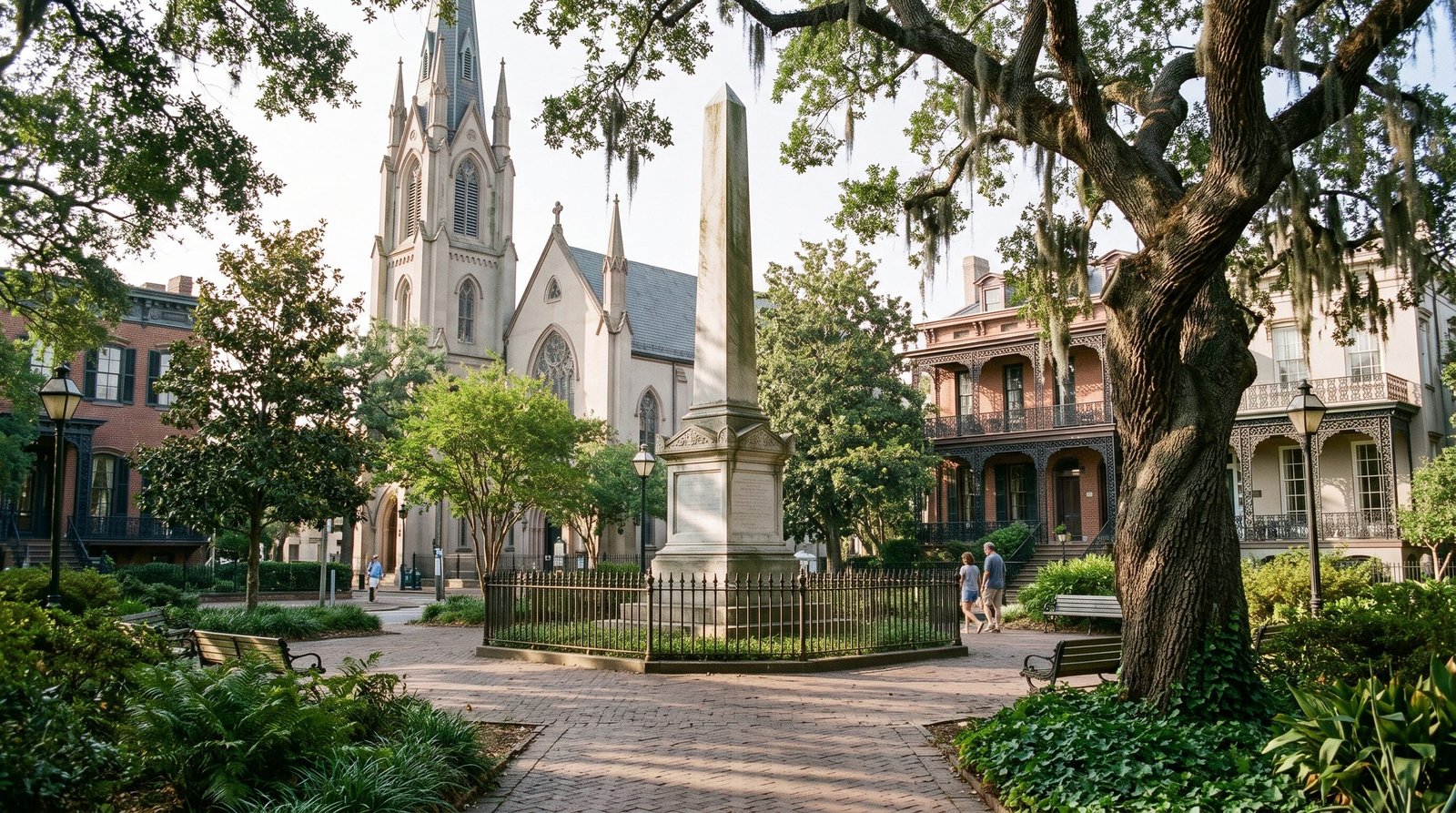
Many people call Monterey Square the prettiest in Savannah. A monument to Count Casimir Pulaski, who died of wounds from the Siege of Savannah, stands in the center. The Mercer House, made famous by Midnight in the Garden of Good and Evil, and Congregation Mickve Israel face the square. Our guide to Midnight in the Garden of Good and Evil locations explains why the house matters.
Lafayette Square
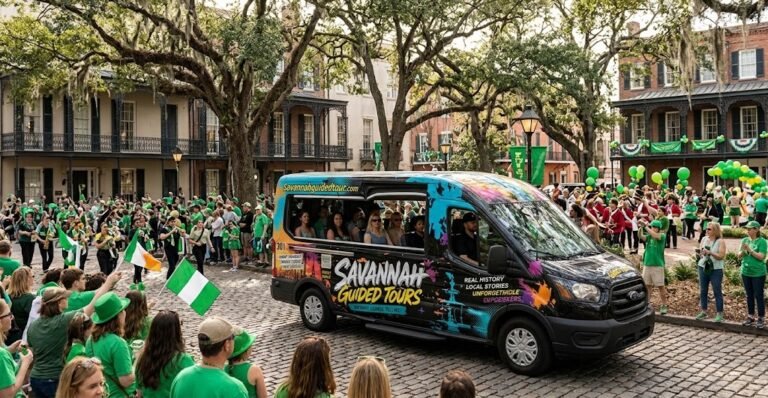
Lafayette Square is named for the Marquis de Lafayette, who visited Savannah in 1825. The twin spires of the Cathedral Basilica of St. John the Baptist rise over the square, and the Flannery O’Connor Childhood Home, the Andrew Low House and the Hamilton-Turner Inn all face it. The fountain in the middle, the Semiquincentenary Fountain, is a popular meeting spot and, in March, one of the city’s green-dyed landmarks.
Reynolds Square
Reynolds Square features a statue of John Wesley, who served as a minister in Savannah in 1736 and 1737. The Olde Pink House, built in 1771, stands on the corner and is the oldest standing structure on the tour route. The Planters Inn and the Lucas Theatre are close by.
Squares for history and architecture lovers
Ellis Square
Ellis Square is the one that came back. It was part of the original plan, was paved for a parking structure in the 1950s and reopened as a public square in 2010. A statue of songwriter Johnny Mercer stands in it, and the fountain is popular with children in summer. City Market is next door. See our post on things to do in Savannah with kids for family tips.
Franklin Square
Franklin Square is home to the First African Baptist Church, which traces its roots to 1773 and is one of the oldest Black congregations in North America. The current building was completed in 1859, built by members of the congregation. A monument in the square honors the Haitian soldiers who fought in the 1779 Siege of Savannah.
Telfair Square
Telfair Square is the center of the city’s art scene. Telfair Academy, in an 1819 mansion designed by William Jay, is the oldest public art museum in the South, and the modern Jepson Center sits beside it. Trinity United Methodist Church also faces the square. See Telfair Museums for hours and exhibitions.
Oglethorpe Square
Oglethorpe Square is named for the founder, though no statue of him stands here. The Owens-Thomas House, another William Jay building from 1819, faces the square. Lafayette addressed the crowd from its balcony during his 1825 visit. The house is one of the best examples of Regency architecture in the country.
Columbia Square
Columbia Square is the site of the Davenport House, built around 1820. The threat of its demolition in 1955 led to the creation of the Historic Savannah Foundation, so this is where the city’s preservation movement began. The square’s fountain came from the Wormsloe plantation.
Greene Square
Greene Square is named for Nathanael Greene, as Johnson Square’s monument is. The Second African Baptist Church, one of the city’s historic Black congregations, faces the square.
Orleans Square
Orleans Square is named for the Battle of New Orleans. Its fountain honors the German societies and immigrants who helped build Savannah. The Harper Fowlkes House, a mid-19th-century mansion, faces the square, and the Civic Center is a short walk away.
Taylor Square
Taylor Square was known as Calhoun Square until the city renamed it in August 2023. The new name honors Susie King Taylor, who grew up in Savannah and became a Civil War nurse and teacher and wrote a memoir of her service. The square holds the Massie Heritage Center, in an 1856 school building, and the Gothic Revival Wesley Monumental United Methodist Church with its twin spires. It is a quieter stop between the busier squares.
The quieter neighborhood squares
Not every square has a famous building. These are the ones residents use as their living rooms.
- Washington Square: Named for George Washington. Close to City Market but calm, with benches and shade.
- Warren Square: One of the smallest squares, a pocket of shade and brick near the riverfront.
- Pulaski Square: Named for Casimir Pulaski, with large oaks and a residential feel.
- Crawford Square: Named for William H. Crawford, a U.S. Treasury Secretary. A gazebo stands at the center.
- Chatham Square: A residential square named for the Earl of Chatham, the namesake of the county, with the preserved Gordon Row nearby.
- Whitefield Square: Named for evangelist George Whitefield. A gazebo at the center is a favorite spot for small weddings and photos.
- Troup Square: Named for Georgia Governor George Troup. An armillary sphere stands in the center, and the row houses around it show how ordinary Savannahians lived in the 1850s.
What about Forsyth Park?
Forsyth Park is not one of the 22 squares. It is a 30-acre park at the southern end of the district, and its white fountain is the image most people have in mind when they picture Savannah. Read our guide to Forsyth Park and its best photo spots for details.
Which squares are best for what
If you do not have time for all 22, pick by interest:
- Photography: Monterey, Lafayette, Chippewa and Forsyth Park in the early morning, when the light comes through the moss and the streets are empty.
- Families: Ellis Square for its fountain, then Forsyth Park for open space and the playground.
- History: Wright, Johnson, Franklin and Madison, each of which has monuments tied to the Revolution, the Civil War or the city’s founding.
- Architecture: Telfair, Oglethorpe and Lafayette for the best of the Regency and Gothic Revival buildings. Our guide to Savannah’s historic homes goes into more detail.
- A quiet break: Warren, Washington, Pulaski and Chatham, which most visitors skip.
- Ghost stories: Johnson, Wright and Madison, which feature in the local legends. Read why Savannah is called America’s most haunted city.
A simple walking route
If you want to walk the squares, this order keeps backtracking to a minimum:
- Start at Johnson Square, then walk to Reynolds Square and Ellis Square near the river.
- Head south to Wright Square and Telfair Square.
- Continue to Chippewa Square and then Madison Square along Bull Street.
- Detour west to Lafayette Square for the cathedral.
- Finish at Monterey Square and walk the last block to Forsyth Park.
That covers the ten most popular squares in about two hours at a relaxed pace. Add the quieter ones if you have the time.
How to see all 22 squares
You have three realistic options:
- On foot, over half a day. Plan three to four hours with stops, more if you go inside buildings. Wear comfortable shoes, and carry water from May to September.
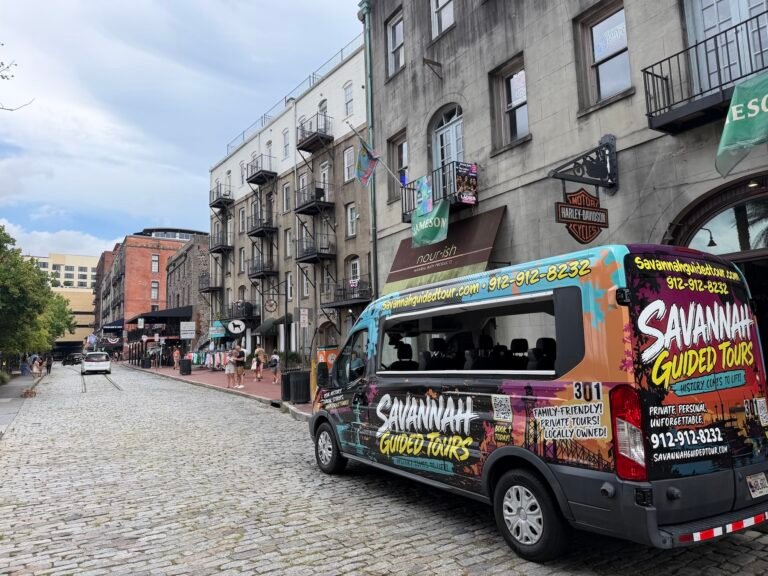
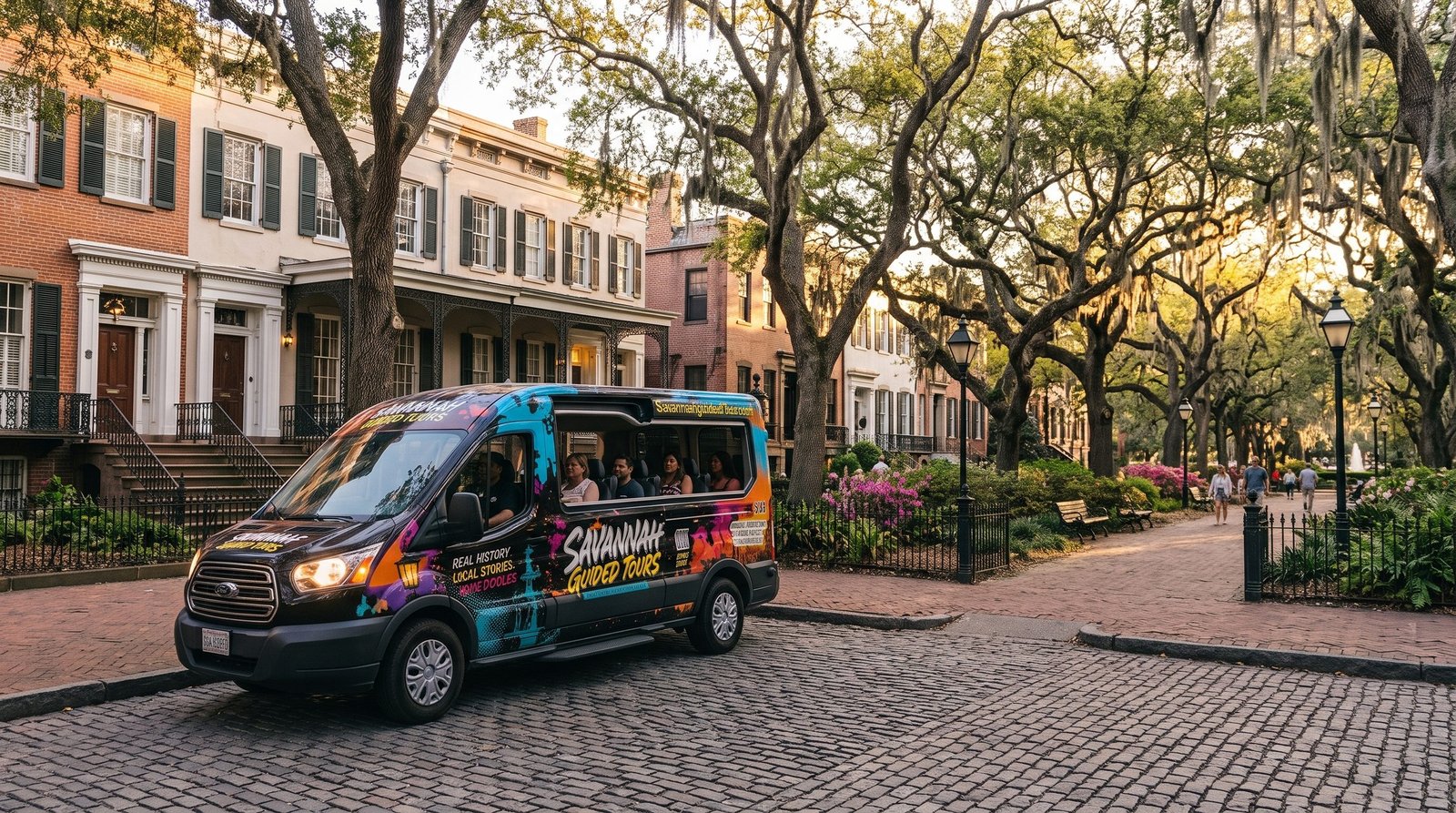
- By guided tour, in 75 minutes. Our open-air tour passes through the heart of the district in a single loop. You see several squares, including Chippewa, Monterey, Lafayette and Reynolds, and hear what is behind each one. It is also the best way to see River Street without walking the cobblestones.
- A mix of both. Ride first, then walk the squares you liked. This is what most of our guests do. Our guide to walking or riding in the Historic District helps you choose.
Tips for visiting the squares
- Go early or late. Midday sun and crowds are hardest in summer.
- Look up. The ironwork, cornices and church spires are as interesting as the monuments.
- Respect the homes. Many buildings around the squares are private residences.
- Read the markers. Almost every monument has a plaque with a short story.
- Mind the traffic. Cars circle each square, so look both ways at every corner.
Frequently asked questions
See the squares with a local guide
Savannah’s squares make more sense with someone explaining what stood here, who it was named for and which house is which. Our 75-minute open-air tour runs through the center of the district and past several of the squares on this list, with a licensed local guide. Book the Savannah Historic District open-air tour and start your trip with the big picture.