
Why Savannah Is Called America’s Most Haunted City: The History Behind the Legends
Every evening, as the light goes, small groups gather in Savannah’s squares to hear ghost stories. There are walking ghost tours, pub crawls, trolley tours and tours in converted hearses. Ask almost anyone who has visited what Savannah is known for, and “haunted” comes up right after the squares and the Spanish moss.
We should say up front that we’re a daytime tour company. We don’t run ghost tours, and we’re not going to tell you whether ghosts are real. What we can do is explain where haunted Savannah comes from: the real history behind the legends, where the title “America’s Most Haunted City” came from, and which places the stories cluster around. Most of those places are just as interesting in daylight.
Quick answer: Savannah is called America’s most haunted city because it’s one of the oldest and best-preserved cities in the country, and its history includes a Revolutionary War battle, the Civil War, major fires, deadly yellow fever epidemics, slavery and thousands of burials in the middle of town. The title itself came from the American Institute of Parapsychology in 2002, which its own founder called more honorary than scientific.
Where the “most haunted city” title came from
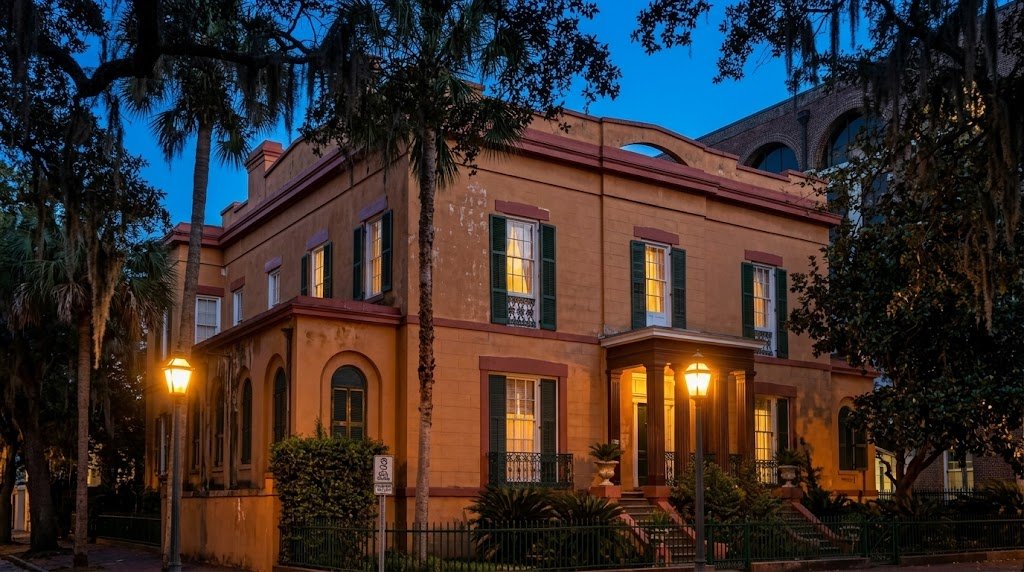
In October 2002, the American Institute of Parapsychology held a conference in Savannah and declared it “America’s Most Haunted City.” It was a good headline, and it stuck.
The fine print is worth knowing. Several other cities have claimed the same title, including New Orleans, Charleston, Philadelphia and Chicago. And the institute’s founder, Andrew Nichols, said at the time that Savannah’s designation was more honorary than scientific. His reasoning was simple: the city has many old buildings that have barely changed and never moved, and a great many people have lived and died in them.
By then, ghost tours were already big business. A newspaper report from the conference counted 21 companies offering tours of haunted Savannah. Today there are many more.
Why is Savannah so haunted? The history behind the stories
Ghost stories tend to grow where history is dense, dramatic and still visible. Savannah has all three.
It’s old, and it survived
Savannah was founded in 1733, and because the city surrendered to General Sherman in 1864 instead of being burned, much of its 18th- and 19th-century fabric is still standing. Old houses creak, settle and have long histories of owners. That’s fertile ground for stories.
War came here twice
On October 9, 1779, American, French and Haitian troops tried to retake British-held Savannah in one of the bloodiest hours of the Revolutionary War. Hundreds were killed or wounded in the assault near today’s Visitor Center and Battlefield Memorial Park. During the Civil War, Union troops occupied the city from December 1864, and buildings such as the Marshall House served as hospitals.
Epidemics filled the cemeteries
Yellow fever struck Savannah repeatedly in the 1800s. In the 1820 epidemic alone, nearly 700 people died, many of them buried in what is now Colonial Park Cemetery. Later outbreaks, including 1854 and 1876, killed hundreds more. Doctors and families didn’t understand how the disease spread, and the fear of those summers left a deep mark on the city.
Fire
Great fires in 1796 and 1820 destroyed large parts of the city. Many of the houses you see today were built on the sites of earlier ones.
Slavery
Savannah’s wealth was built on enslaved labor, from the rice and cotton plantations upriver to the house staff in the mansions on the squares. Many of Savannah’s ghost stories involve enslaved people, and it’s worth remembering that behind those stories were real people whose lives were rarely recorded. Some of the city’s museums, particularly the Owens-Thomas House & Slave Quarters, now tell that history directly.
The dead are close at hand
Colonial Park Cemetery, in the middle of the Historic District, holds an estimated 9,000 graves from 1750 to 1853, though only a fraction of the headstones survive. The Yamacraw chief Tomochichi, who helped Oglethorpe found the colony, is buried in Wright Square. In a city this old, it’s easy to believe that the past isn’t far below the pavement.
The most haunted places in Savannah (and the history behind each)
These are the places that come up again and again in Savannah ghost stories. For each, we’ve separated what’s documented from what’s legend.
Colonial Park Cemetery
The history: Savannah’s main burial ground for a century, holding Revolutionary War figures, early governors, duelists and victims of the 1820 yellow fever epidemic. When Union troops occupied the city in 1864, some camped in the cemetery, and many headstones were damaged. Stones later found out of place are mounted along the back wall.
The legend: Figures in colonial dress walking among the graves at night, and a general eerie reputation that makes it the most visited stop on almost every ghost tour.
Mercer-Williams House
The history: The Italianate mansion on Monterey Square where antiques dealer Jim Williams shot Danny Hansford in 1981. Williams was tried four times before being acquitted, and the case became Midnight in the Garden of Good and Evil. Williams himself died in the house in 1990.
The legend: Stories of unexplained activity in the house, fueled mostly by the book and its notoriety. Williams also claimed strange experiences in another house he restored, the Hampton-Lillibridge House, where he arranged an exorcism.
Sorrel-Weed House
The history: A Greek Revival house on Madison Square completed around 1840 for merchant Francis Sorrel, and visited by Robert E. Lee.
The legend: Tales of tragedy in the Sorrel household, and a place on paranormal TV shows. The house leans into its reputation and runs evening ghost tours, alongside daytime history tours.
The Marshall House
The history: One of Savannah’s oldest hotels, opened in 1851 on Broughton Street. It served as a Union hospital during the Civil War and is also said to have cared for patients during the city’s yellow fever epidemics.
The legend: Guests report footsteps, running water and children in the halls. The American Institute of Parapsychology held its 2002 conference here.
Wright Square and Alice Riley
The history: Alice Riley, an Irish indentured servant, was hanged in 1735 for the murder of her master, William Wise. She is often described as the first woman executed in the Georgia colony, and the hanging is traditionally placed in Wright Square.
The legend: Some say Spanish moss won’t grow on the square’s trees because of the hanging. Look up when you’re there and judge for yourself.
Moon River Brewing Company
The history: The building on Bay Street opened in 1821 as the City Hotel, one of Savannah’s early hotels.
The legend: It’s often called one of the most haunted buildings in the city, especially its upper floors and basement, and it features on several paranormal TV shows.
The Pirates’ House
The history: Near Trustees’ Garden, the site of Georgia’s first experimental garden, parts of this building date to the mid-1700s, when it was a tavern for sailors near the river.
The legend: Stories of sailors being drugged and “shanghaied” through tunnels to waiting ships, and of Captain Flint from Treasure Island dying upstairs. Robert Louis Stevenson mentions Savannah in the novel, which gives the restaurant a good story to tell.
Bonaventure Cemetery and Little Gracie
The history: Just east of the city, Bonaventure is one of the most beautiful cemeteries in the country. Among its best-known graves is that of Gracie Watson, who died of pneumonia in 1889 at the age of six. Her parents commissioned a life-size marble statue of her, now protected by a fence.
The legend: Visitors leave toys and coins for Gracie, and some say the statue’s expression changes. Bonaventure is open only in daylight, which suits the history better than the ghost stories anyway.
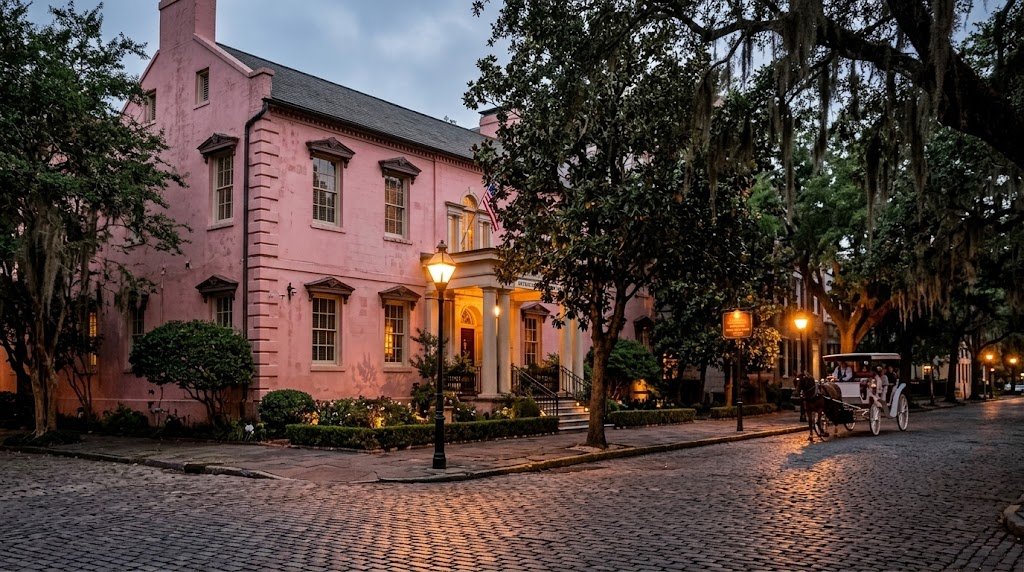
The Olde Pink House
The history: Built in 1771 for James Habersham Jr. on Reynolds Square, and now a well-known restaurant.
The legend: A friendly ghost said to be Habersham himself, seen in the basement tavern.
How to see haunted history in Savannah in daylight
You don’t need a lantern to appreciate the history behind Savannah ghost stories. Most of the places above are public or open during the day:
- Colonial Park Cemetery is a city park, open in daylight. Read the markers, including the one for the 1820 yellow fever epidemic.
- Bonaventure Cemetery is free and open daily from 8:00 AM to 5:00 PM.
- The Mercer-Williams House offers daytime tours of the ground floor, and Monterey Square is lovely at any hour.
- The Sorrel-Weed House runs daytime history tours as well as ghost tours.
- The Owens-Thomas House & Slave Quarters gives the fullest picture of how these houses worked and who worked in them.
- Wright Square, Reynolds Square and Madison Square are all a few minutes’ walk apart.
For more on the houses themselves, read our guide to Savannah’s most beautiful historic homes and mansions.
Should you take a ghost tour?
If you enjoy ghost stories, yes. Evening ghost tours are a Savannah tradition, the squares feel different after dark, and a good guide is great entertainment. Just go in knowing that you’re hearing folklore and storytelling, often built around real events. The best guides are clear about which is which.
A few tips:
- Check the age policy. Some ghost tours, especially pub crawls and late-night tours, are for adults only.
- Wear comfortable shoes. Many ghost tours are on foot, often over uneven brick.
- Do a daytime tour first. Seeing the city in daylight gives you the history, so the evening stories mean more. Our weekend itinerary shows how to fit both in.
- Book early in October. Halloween season is the busiest time for ghost tours.
Frequently asked questions
See the history by daylight
We don’t do ghost tours, but you’ll see many of these houses and squares on our daytime tour. The 75-minute Savannah Historic District Open-Air Cruiser Tour passes Monterey Square and the Mercer-Williams House, Reynolds Square and the Olde Pink House, Chippewa Square and Factors Walk, with a local guide telling the real history behind them. Then decide for yourself what walks there at night.
One Comment