One Day in Savannah: A Realistic Itinerary for First-Time Visitors
Most one-day guides to Savannah are written by people who have never tried to do it. They list twenty attractions, ignore the fact that the Historic District is two and a half square miles of humid pavement, and quietly assume you can park wherever you like.
This one is different. If you are looking for things to do in Savannah in one day and you want a plan that survives contact with reality, here is an hour-by-hour itinerary built around how long things actually take, where you can actually leave your car, and what a first-time visitor genuinely regrets missing.
Can you really see Savannah in one day?
You can see the Historic District in one day. You cannot see Savannah in one day.
The difference matters. The Historic District is compact, walkable in parts, and holds nearly everything a first-time visitor pictures when they think of the city: the squares, Forsyth Park, River Street, the Cathedral, the mansion rows. That is a full and satisfying day.
What does not fit is everything outside it. Bonaventure Cemetery, Wormsloe’s oak avenue, Tybee Island, the Pin Point Heritage Museum. Each of those is a half-day round trip once you factor in driving and parking. Trying to squeeze one in is the single most common way first-timers ruin an otherwise good day.
Short answer: One day in Savannah is enough for the Historic District — roughly ten major landmarks, River Street, and a proper dinner. It is not enough to add Tybee Island, Bonaventure Cemetery, or Wormsloe. Pick the district and do it well.
Before you start: solve parking first
Savannah’s Historic District has metered street parking and a handful of city-run garages. Street meters are enforced Monday through Saturday and are usually free on Sundays, though the city updates hours and rates periodically — check the City of Savannah parking pages before you arrive.
For a full day, a garage beats the street. The main city garages are Bryan Street, State Street, Whitaker Street, Liberty Street and Robinson. All of them have daily maximum rates, all of them are within a few minutes’ walk of a square, and none of them require you to move your car every two hours. Paying for a garage is not the expensive option. Circling for forty minutes and then getting ticketed is.
If you are driving in from I-95 or from the airport, aim to be parked before 9:30 a.m. Street parking near the squares is largely gone by mid-morning between March and June.
The itinerary, hour by hour
9:30 a.m. — Coffee and a first look at a square
Park, then walk to the nearest square and sit in it for fifteen minutes. This sounds like wasted time. It is not. Savannah’s squares are the thing that makes the city different from every other American downtown, and they are much easier to understand once you have been inside one before someone starts explaining them to you.
Chippewa, Madison and Wright are all good starting points, and all three have coffee within a block.
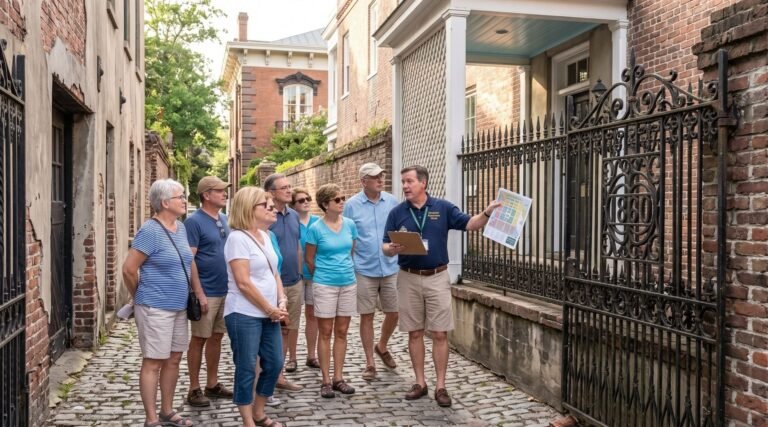
10:00 a.m. — Take an orientation tour
This is the decision that shapes the rest of the day.
The Historic District is bigger than it looks on a map. Forsyth Park sits at the southern end, River Street at the northern edge, and the walk between them is close to a mile and a half of flat, exposed, often humid ground. Doing that cold, on your first morning, with no idea which square is which, is how people end up seeing four things and calling it a day.
A guided loop fixes this. The Savannah Historic District Open-Air Bus Tour covers roughly ten landmarks in 75 minutes, with a licensed local guide narrating and photo stops at the Cathedral Basilica and Monterey Square. The first departure is at 10 a.m. from 405 E Gaston Street, at the north edge of Forsyth Park. By 11:15 you have seen the whole district once, you know what you want to come back to, and you have not spent your energy budget before lunch.
If you would rather move slowly and go where a vehicle cannot, the Savannah Historic District Walking Tour covers the core of the same ground on foot in two hours.
11:30 a.m. — Forsyth Park
You are already there when the bus tour ends. Give it forty-five minutes.
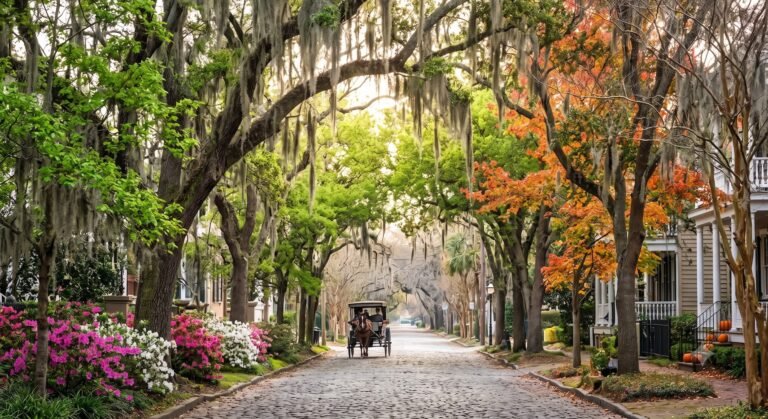
Walk the central path to the 1858 cast-iron fountain, which is the image most people have in their heads when they picture Savannah. The oak allée on either side of that path is the best photograph you will take all day. If the heat is already unpleasant, the western half of the park holds more shade.
12:30 p.m. — Lunch on or near Broughton Street
Broughton is the district’s main commercial street and the easiest place to eat without a reservation. It is also where you will find Leopold’s Ice Cream, which has been operating since 1919 and reliably has a queue down the block. If the line is long at lunch, come back at 4 p.m. instead — it moves faster than it looks either way.
2:00 p.m. — Go inside one building
One. Not four.
House museums take an hour each including the wait, and they are far more similar to one another than the brochures suggest. Choose based on what you actually want:
- Owens-Thomas House & Slave Quarters — the strongest interpretation of enslaved labour in the district, and the most honest account of how the wealth on display was produced.
- Mercer-Williams House on Monterey Square — the one Midnight in the Garden of Good and Evil readers come for.
- Davenport House Museum — the building that started the city’s preservation movement in 1955, and the best explanation of why the Historic District still exists.
- Cathedral Basilica of St. John the Baptist — free to enter, no ticket, closed to sightseeing during services. The fastest interior on this list if you are short on time.
3:30 p.m. — Walk Jones Street and the lanes
Jones Street is the one people photograph, and it deserves it. But the more interesting walk is the service lanes running behind the main streets — narrow, brick, half-forgotten, and the only place you get a sense of how the city was actually organised.
This is a genuinely pleasant hour on foot, in shade, with almost nobody around.
5:00 p.m. — River Street and Factors Walk
Come down to the river in the late afternoon rather than at midday. The light is better, the cruise crowds have thinned, and the cobblestones are less punishing once the sun is off them.
Two things worth knowing. First, the stone ramps and stairways down from Bay Street are steep and uneven — the elevator in City Hall’s vicinity and the ramp at the western end are the easier routes. Second, Factors Walk, the multi-level iron bridgeway above the cobblestones, is more interesting than River Street itself and most visitors walk straight past it.
6:30 p.m. — City Market, then dinner
City Market is four pedestrian blocks of galleries, bars and restaurants, and it is where most people end up after the riverfront. It is also the answer to “what do we do now” if your group cannot agree on dinner.
One local rule worth knowing: Savannah permits open containers within the Historic District, in plastic cups under a set size limit. Glass is not allowed and the boundaries are real. This surprises almost every first-time visitor.
If you only have half a day
Drop the house museum and Jones Street. Take the 10 a.m. or 11:30 a.m. tour, spend an hour in Forsyth Park, eat on Broughton, and finish on River Street. That is a legitimate four hours and it covers more than most people manage in eight.
If you are arriving by cruise ship
Savannah’s cruise passengers usually dock at ports up the coast and arrive by coach with a fixed return time, which means your real constraint is the bus back, not the daylight.
Do the orientation loop first, immediately. Whatever time you have left, spend it on foot in the two or three squares your guide flagged. Do not attempt River Street and Forsyth Park on the same short visit unless you have a car — they are at opposite ends of the district.
Three things first-timers get wrong
Underestimating the distances. Savannah is flat, which makes maps deceiving. Forsyth Park to River Street is a real walk in July.
Booking a house museum for the morning. The morning is when you should be building a mental map of the city. Interiors are better in the afternoon, when the heat has peaked and you want to be inside anyway.
Trying to add Tybee Island. It is about eighteen miles east, roughly twenty-five minutes each way in light traffic and considerably more on a summer weekend. Add parking at the beach and you have spent four hours. Save it for a second day.
What to skip on a one-day visit
- Bonaventure Cemetery — beautiful, and a half-day commitment
- Wormsloe Historic Site — the oak avenue is ten miles south, plus an entry fee
- Tybee Island — a separate trip, not an add-on
- More than one house museum — diminishing returns after the first
- Ghost tours, unless you are staying the night. They start after dark, which conflicts with dinner and with leaving.
Frequently asked questions
How many hours do you need in Savannah?
One full day of eight to ten hours covers the Historic District properly, including a guided orientation, Forsyth Park, River Street and one interior. Two days lets you add Bonaventure Cemetery or Tybee Island without rushing. Anything under four hours means choosing between the riverfront and the park.
Is Savannah walkable in a day?
The Historic District is walkable, but the full north-to-south distance is about a mile and a half each way on flat, exposed ground. Most visitors comfortably cover the central squares on foot and use a guided tour or a vehicle for the stretch between Forsyth Park and River Street.
What is the best time of day to start?
Between 9 and 10 a.m. Parking is still available, the first tour departures run at 10 a.m., and you finish the outdoor portion of the day before the afternoon heat peaks. Starting after noon in summer costs you the most comfortable hours.
Can you do Savannah in one day without a car?
Yes, if you are staying downtown or arriving by coach. The Historic District is compact enough to cover on foot with a guided tour handling the longer stretches. A car only becomes necessary for Bonaventure Cemetery, Wormsloe or Tybee Island.
Is one day in Savannah enough?
For a first visit focused on the Historic District, yes. You will see the squares, the fountain, the riverfront and the architecture that the city is known for. What one day does not allow is the coastal and cemetery sites outside downtown, which need a second day.
Start the day with an overview
Everything in this itinerary works better if you know the shape of the city before you start walking it. The Savannah Historic District Open-Air Bus Tour runs five times daily from 10 a.m., takes 75 minutes, and leaves from the north edge of Forsyth Park — which is exactly where you want to be standing at 11:15 anyway.
Small groups fill quickly in spring and autumn. Book ahead where you can, or get in touch if you are travelling with a group and need a private departure.
Ready to See Savannah?
Seventy-five minutes, ten landmarks, and a guide who knows which square is which. Small groups fill quickly in spring and autumn — book ahead where you can.