
Savannah’s Most Beautiful Historic Homes and Mansions
Savannah is a city you mostly look at from the sidewalk. The best historic homes in Savannah sit shoulder to shoulder around the squares, close enough to the street that you can see the ironwork on the stair rails and the fanlights over the doors. A few are open as museums. Most are still private homes, which is part of why the Historic District still feels like a neighborhood rather than a theme park.
This guide covers the Savannah mansions worth knowing: the house museums you can tour, the famous houses to admire from outside, and a short primer on Savannah architecture so you can tell a Regency house from a Greek Revival one as you walk.
Quick answer: The most beautiful historic homes in Savannah you can tour are the Owens-Thomas House, Davenport House, Mercer-Williams House, Andrew Low House, Green-Meldrim House, Juliette Gordon Low Birthplace, Harper Fowlkes House and Sorrel-Weed House. Many are on or near Monterey, Madison, Lafayette, Oglethorpe and Columbia squares, and most house museums charge roughly $10 to $25.
Why there are so many historic homes in Savannah
Three things explain it.
The plan. When James Oglethorpe laid out Savannah in 1733, he organized it into wards built around public squares. Houses went up facing the squares and the streets between them, so the city grew in tidy, walkable blocks. Twenty-two of those squares survive.
The war didn’t burn it. When General Sherman reached Savannah in December 1864 at the end of his March to the Sea, the city surrendered rather than fight. Sherman offered Savannah to President Lincoln as a Christmas present, and the antebellum homes that would have been lost elsewhere were left standing.
Seven women and a house. By the 1950s, many old houses were being torn down for parking lots and gas stations. In 1955, when the Davenport House was about to be demolished, seven local women raised the money to buy it. They formed the Historic Savannah Foundation, which went on to save hundreds of buildings. In 1966, the Savannah Historic District became a National Historic Landmark District.
Historic house tours in Savannah: the homes you can go inside
Owens-Thomas House & Slave Quarters
Oglethorpe Square, 124 Abercorn Street. Completed 1819. Architect: William Jay.
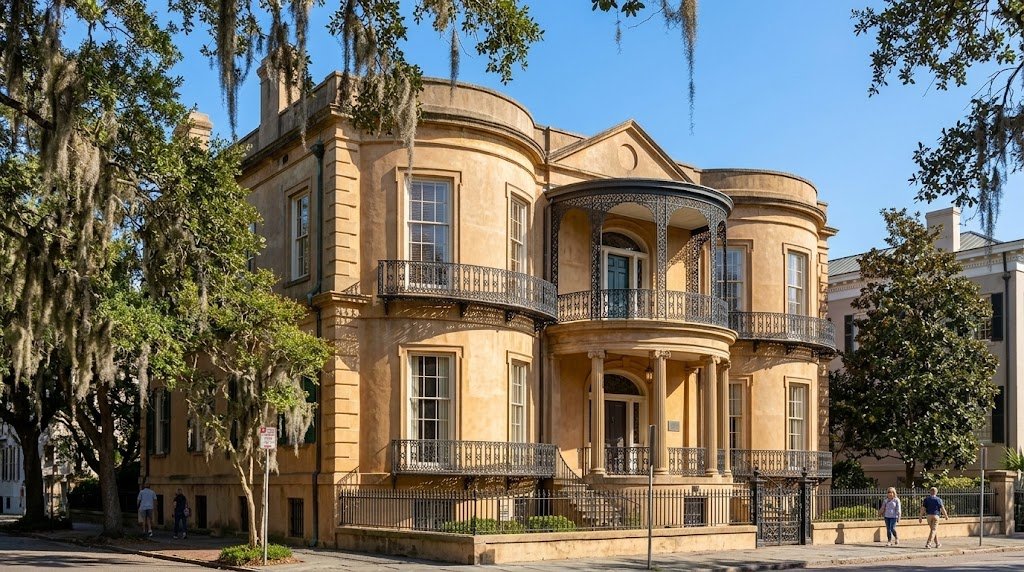
If you tour only one house, make it this one. William Jay, a young English architect, brought the Regency style to Savannah, and this is his finest house: curving walls, a bridge across the upstairs hall, and one of the earliest indoor plumbing systems in the country. In 1825 the Marquis de Lafayette addressed a crowd from its side balcony.
What makes the tour stand out is the carriage house behind it, where the house’s enslaved workers lived. Its ceilings still carry original “haint blue” paint, and the museum, run by Telfair Museums, tells their story alongside the owners’. It’s an honest look at how these houses actually worked.
Davenport House Museum
Columbia Square, 324 East State Street. Built 1820. Builder: Isaiah Davenport.
A red-brick Federal-style house built by a master carpenter for his own family. It’s elegant without being showy, with a graceful double staircase at the entrance and a fine elliptical stair inside. It’s also the house that started Savannah’s preservation movement: saving it in 1955 led to the Historic Savannah Foundation.
Mercer-Williams House
Monterey Square, 429 Bull Street. Designed around 1860, completed after the Civil War. Architect: John S. Norris.
The most famous house in Savannah, thanks to John Berendt’s Midnight in the Garden of Good and Evil. It was designed for General Hugh W. Mercer, the great-grandfather of songwriter Johnny Mercer, though no Mercer ever lived in it. Antiques dealer Jim Williams bought and restored it after 1969 and was later tried four times for the 1981 shooting of Danny Hansford inside, before being acquitted.
The Italianate house, with its tall arched windows and iron balconies, is the centerpiece of what many consider Savannah’s prettiest square. Tours cover the ground floor and Williams’s collection of furniture and art.
Andrew Low House
Lafayette Square, 329 Abercorn Street. Built 1848–49. Attributed to John S. Norris.
Built for cotton merchant Andrew Low, this Italianate house hosted William Makepeace Thackeray and Robert E. Lee. It’s also where Juliette Gordon Low, Andrew Low’s daughter-in-law, lived as an adult and founded the Girl Scouts in 1912. She died in the house in 1927. The Colonial Dames of America own it and run the tours.
Green-Meldrim House
Madison Square, 14 West Macon Street. Built early 1850s. Architect: John S. Norris.
The finest Gothic Revival house in Savannah, with pointed arches, cast-iron porches and an oriel window. It was built for cotton merchant Charles Green, who offered it to General Sherman as his headquarters in December 1864. It’s said that Sherman wrote the famous telegram offering Savannah to Lincoln from here. Today it serves as the parish house of St. John’s Episcopal Church next door, and tour days are limited, so check before you go.
Juliette Gordon Low Birthplace
10 East Oglethorpe Avenue. Built around 1821. Attributed to William Jay.
The childhood home of the founder of the Girl Scouts, restored to how it looked in the 1880s. It’s a pilgrimage site for scouts from all over the country, and the guided tour is one of the most polished in the city.
Harper Fowlkes House
Orleans Square, 230 Barnard Street. Built 1842. Architect: Charles Cluskey.
A Greek Revival mansion with a grand columned portico and a fine collection of antiques. It’s named for Alida Harper Fowlkes, an early preservationist who bought and restored it in the 1930s. It’s now part of the Coastal Heritage Society’s group of museums.
Sorrel-Weed House
Madison Square, 6 West Harris Street. Completed around 1840. Architect: Charles Cluskey.
A Greek Revival and Regency house built for merchant Francis Sorrel. It offers daytime history tours and, in the evening, some of the best-known ghost tours in town. If that side of Savannah interests you, read our piece on why Savannah is called America’s most haunted city.
Scarbrough House and Telfair Academy
Two more William Jay buildings finished in 1819. The Scarbrough House on Martin Luther King Jr. Blvd was built for William Scarbrough, a backer of the SS Savannah, the first steamship to cross the Atlantic, and now holds the Ships of the Sea Maritime Museum. The Telfair Academy on Telfair Square began as a family mansion and became the oldest public art museum in the South.em. Climbing up into a carriage can be awkward, though, so ask the company how high the step is before you book.
Savannah mansions to admire from the street
Some of the city’s best houses aren’t museums. You’ll see them from the sidewalk, or from a seat on a tour.
- The Olde Pink House on Reynolds Square. Built in 1771 for James Habersham Jr., it’s one of the oldest buildings in the city and is now a restaurant, so you can go in for dinner.
- Hamilton-Turner House on Lafayette Square. A Second Empire mansion from 1873 with a mansard roof, said to be one of the first houses in Savannah with electric lights. It’s now an inn.
- Kehoe House on Columbia Square. A brick Queen Anne house from 1892 built by an iron foundry owner, and full of decorative ironwork. Also an inn.
- The Gingerbread House on Bull Street, south of Forsyth Park. A wooden Victorian house with lacy “Steamboat Gothic” trim, used today for private events.
- The Victorian District. South of Forsyth Park, whole streets of wooden Victorian houses with deep porches and turrets show a very different Savannah from the brick townhouses up north.
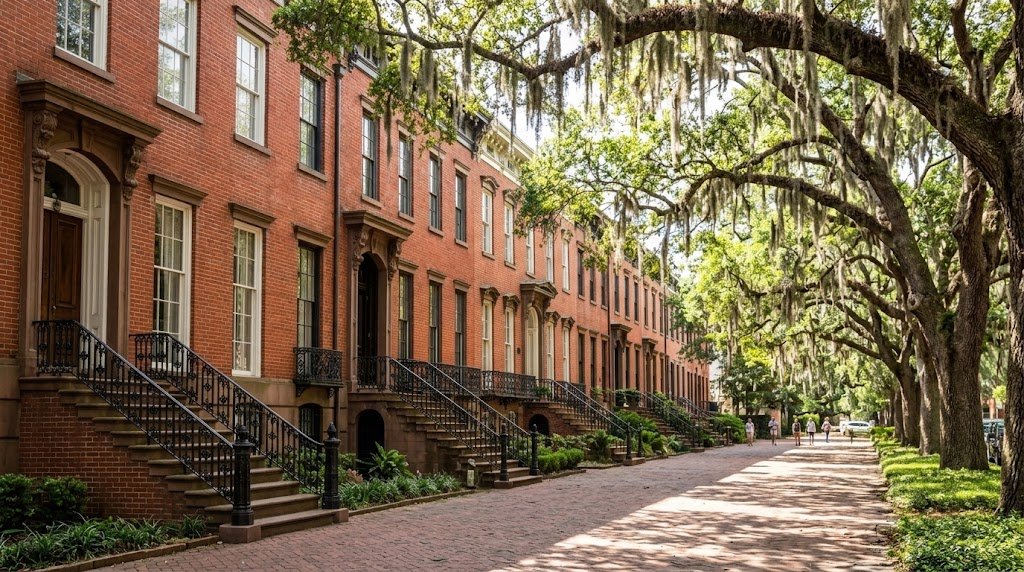
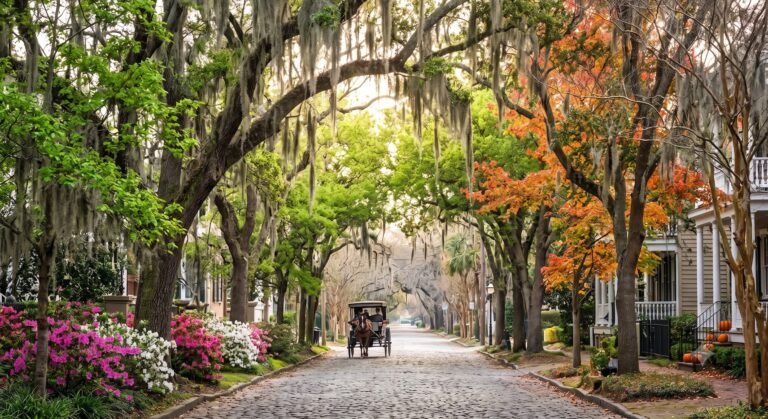
- Jones Street. Not one mansion but a whole row of 19th-century townhouses under a canopy of oaks. Often called one of the most beautiful streets in America.
Please remember that the homes on this list, apart from the museums and inns, are private. Admire from the sidewalk and don’t climb the steps for photos.
A quick guide to Savannah architecture
You don’t need to be an architect to enjoy the houses, but knowing a few styles makes the walk more fun.
| Style | When | What to look for | Where to see it |
|---|---|---|---|
| Georgian and Colonial | 1700s | Simple symmetry, stucco over brick | Olde Pink House |
| Federal | About 1790–1830 | Red brick, fanlights over doors, delicate details | Davenport House |
| Regency | About 1815–1830 | Curved walls, columns, English influence | Owens-Thomas House, Telfair Academy |
| Greek Revival | About 1830–1860 | Columned porticos, temple-like fronts | Harper Fowlkes House, Sorrel-Weed House |
| Gothic Revival | 1840s–1860s | Pointed arches, crenellations, cast iron | Green-Meldrim House |
| Italianate | 1840s–1880s | Tall arched windows, brackets under the eaves | Mercer-Williams House, Andrew Low House |
| Second Empire | 1860s–1880s | Mansard roofs | Hamilton-Turner House |
| Queen Anne and Victorian | 1880s–1900s | Turrets, porches, wood trim | Kehoe House, the Victorian District |
Two Savannah details to watch for everywhere: ironwork, cast in local foundries and used for balconies, stair rails and fences, and stoops, the tall front stairs that lifted living quarters above the dirt and mud of 19th-century streets.
Antebellum homes in Savannah: what to expect
If you’re picturing plantation houses with white columns and long drives, Savannah is different. The antebellum homes in Savannah are city houses: townhouses and mansions built close to the street, often sharing walls with their neighbors, with gardens tucked behind. The grand plantation-style avenue most people imagine is at Wormsloe, just outside the city, where a mile and a half of live oaks leads to the tabby ruins of a colonial estate.
It’s also worth remembering who built and ran these houses. Many were built and maintained by enslaved people, and the best house museums now tell that part of the story too. The Owens-Thomas House is the clearest example.
How to plan a historic homes day
- Tour two houses, not five. Each tour takes 30 to 60 minutes. Two in a day leaves time to enjoy the squares in between.
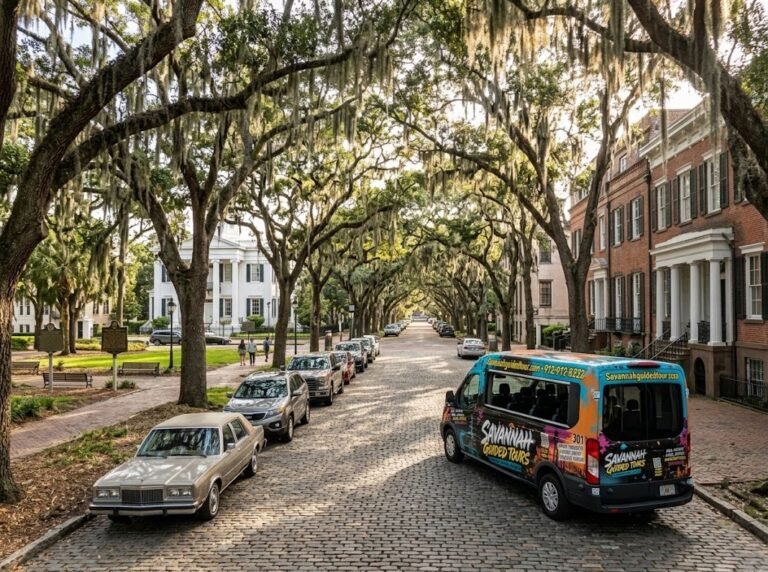
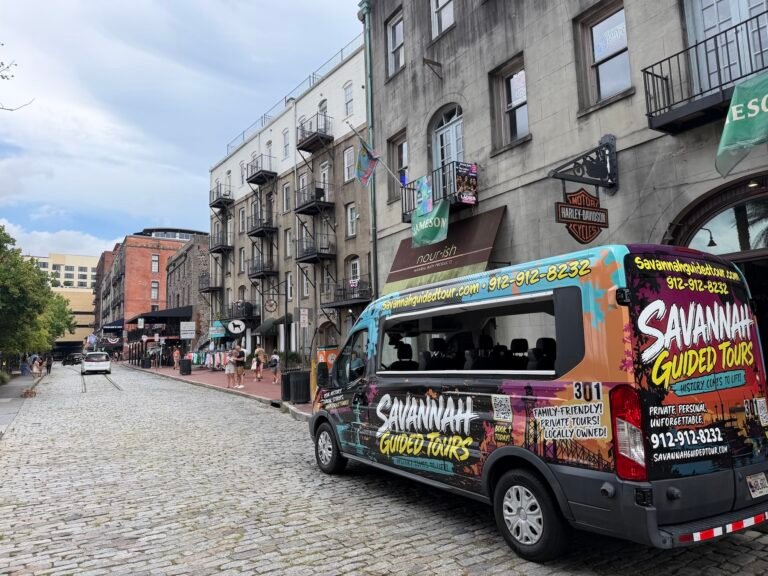
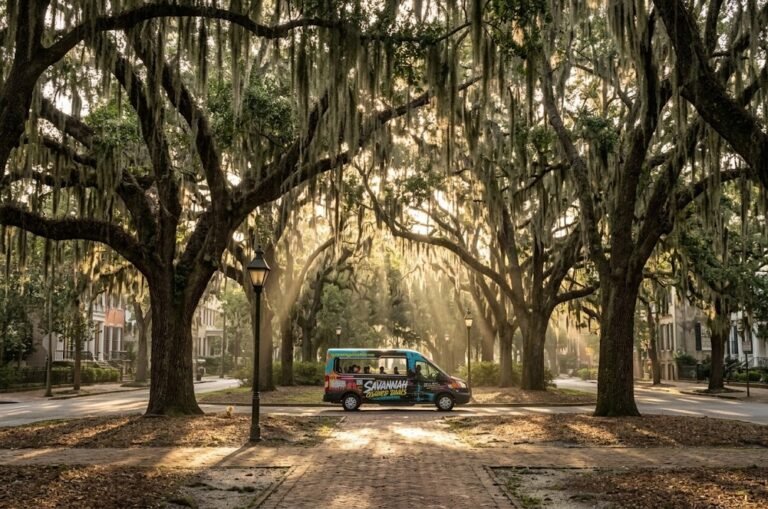
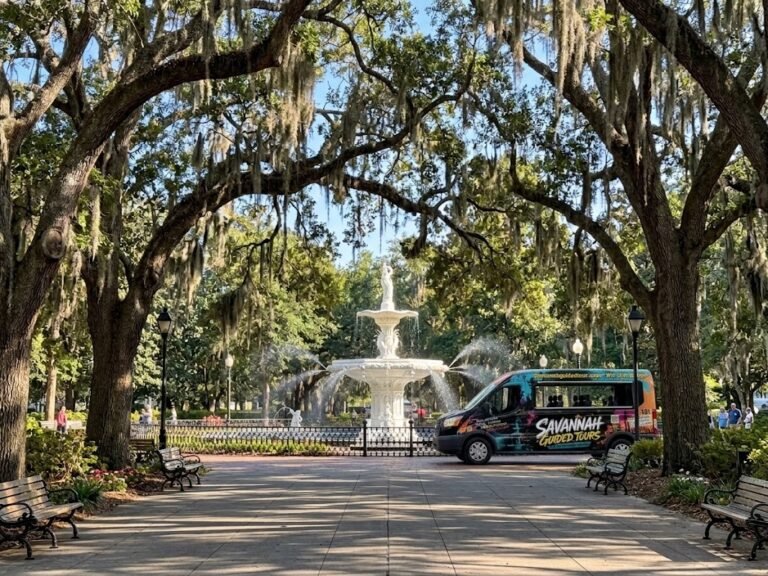
- Start with an overview. Our 75-minute open-air tour passes the Mercer-Williams House, the Olde Pink House and the Victorian mansions around Forsyth Park, and gives you the layout before you choose which houses to go inside.
- Check the days. Several house museums close one or two days a week, and the Green-Meldrim House has limited tour days.
- Walk between them. Most of the houses above are within a mile of each other. Our one-day itinerary shows how the Historic District fits together.
- Book ahead in spring. March to May is the busiest season, and small house tours fill up.
- Park once. Our Historic District parking guide covers the garages closest to the squares.
Frequently asked questions
See the mansions before you choose
Savannah has more beautiful houses than anyone can tour in one trip. Our 75-minute open-air tour takes you past the mansion district, Monterey Square and the Victorian houses around Forsyth Park with a local guide who knows the story behind each facade. Then pick the two you want to see inside.
One Comment