Best Time to Visit Savannah: Month-by-Month Weather, Crowds and Costs
Ask ten people about the best time to visit Savannah and nine will say spring. They are not wrong, but they are answering a different question than the one most travellers are actually asking.
Spring is when Savannah looks best. It is also when hotel rates peak, when the squares are busiest, and when a single weekend in March fills the entire city. If your priority is cost, or quiet, or being able to walk outdoors at 2 p.m. without regretting it, the right month for you might be November.
This is a month-by-month breakdown of what Savannah is actually like — the weather, the crowd level, what you will pay, and what is happening.
The short answer
Best overall: Late March to early May, and October to early November. Comfortable temperatures, everything open, gardens or autumn light.
Best value: Mid-January to late February. Lowest hotel rates, thinnest crowds, and cool but perfectly walkable weather.
Avoid if you can: The week around St. Patrick’s Day in March, when rates and crowds both spike. And July and August, unless you plan around the heat.
Month by month
| Month | Avg high / low (°F) | Crowds | Hotel prices | Notes |
|---|---|---|---|---|
| January | 61 / 39 | Lowest | Lowest | Cool, quiet, everything open |
| February | 64 / 42 | Low | Low | Best value month; early blooms begin |
| March | 71 / 48 | Very high | Peak | St. Patrick’s Day dominates the month |
| April | 78 / 55 | High | High | Azaleas, ideal walking weather |
| May | 85 / 64 | Moderate | Moderate | Warm but still pleasant; humidity rises |
| June | 90 / 71 | Moderate | Moderate | Hot; hurricane season opens 1 June |
| July | 92 / 74 | Moderate | Lower | Hottest and among the wettest months |
| August | 91 / 74 | Lower | Lowest of summer | Heat and humidity peak |
| September | 87 / 69 | Low | Low | Peak hurricane risk; still hot |
| October | 79 / 58 | High | High | Arguably the best month overall |
| November | 71 / 48 | Moderate | Moderate | Excellent weather, thinner crowds |
| December | 63 / 41 | Moderate | Moderate | Cool, decorated, busy around holidays |
Figures are long-term averages and will vary year to year. Treat them as a planning guide, not a forecast. The National Weather Service Charleston office covers the Savannah area for current conditions.
Spring: March to May
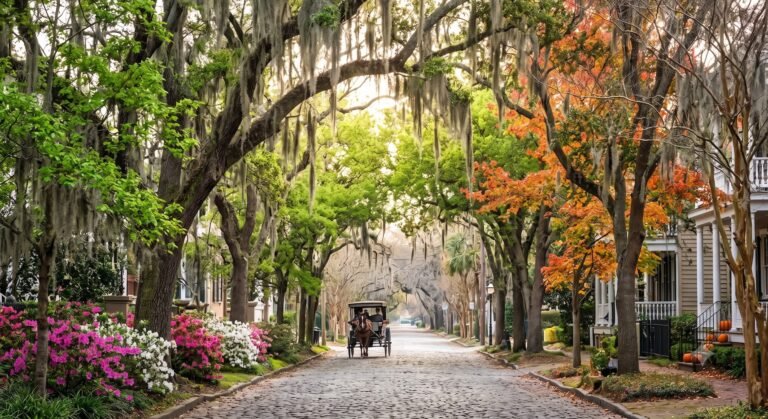
Spring is the season Savannah is photographed in. Azaleas come out in late March and early April, the live oaks are in new leaf, and daytime temperatures sit in a range where walking all day is genuinely comfortable.
The complication is March. Savannah hosts one of the largest St. Patrick’s Day celebrations in the United States, and it does not behave like a normal event. Hotel rates in the Historic District multiply, minimum-night requirements appear, and the streets around the parade route are effectively closed to ordinary sightseeing. If you want spring without the crowd, come in the second half of April.
Late April and early May are the sweet spot: warm days, tolerable humidity, gardens still in colour, and rates that have come back down from the March peak.
Best for: photographers, garden visitors, anyone who wants to walk all day.
Watch out for: March rates, and pollen, which is heavy in the region.
Summer: June to August
Savannah summers are hot and humid, with highs in the low 90s and overnight lows that barely drop below the mid 70s. Afternoon thunderstorms are common, usually brief, and often clear within the hour.
This is not a reason to stay away. It is a reason to restructure the day. Locals do outdoor things before 11 a.m. and after 5 p.m., and spend the middle of the day indoors or in shade. Visitors who follow that pattern have a fine time. Visitors who plan a two-hour walking tour for 2 p.m. in August do not.
Practical adjustments that work:
- Take guided tours in the morning, ideally the first departure
- Choose an open-air tour with a canopy over walking, since moving air beats standing in it
- Save house museums, the SCAD Museum of Art and lunch for the 12 to 4 window
- Carry more water than seems necessary, and reapply sunscreen
Hurricane season officially runs 1 June to 30 November, with the highest risk in late August and September. Direct hits on Savannah are uncommon, but the practical effect for travellers is that trip insurance is worth more in September than in February.
Best for: budget travellers, families tied to school holidays, beach add-ons at Tybee.
Watch out for: midday heat, and September storm risk.
Autumn: September to November
September is still summer in everything but name. October is when the city turns.
October and early November give you the year’s most reliable combination: daytime highs in the 70s, low humidity, long golden light in the late afternoon, and no need to plan the day around the heat. Crowds are real but manageable, and unlike March there is no single weekend that swallows the city.
Halloween is busy — Savannah leans into its ghost-tour reputation — but the pressure is concentrated in the evenings rather than across the whole day.
November is the quiet secret. The weather is nearly as good as October, the crowds have thinned, and rates ease off until the week of Thanksgiving.
Best for: first-time visitors, walking tours, photography.
Watch out for: October books up earlier than people expect.
Winter: December to February
Savannah winters are cool rather than cold. Daytime highs sit in the low 60s, overnight lows near or just above freezing, and hard freezes are rare. The live oaks are evergreen, so the city does not go bare the way northern cities do.
December is decorated and pleasant, with a busy stretch around the holidays. January and February are the quietest and cheapest weeks of the year, and they are considerably better for sightseeing than their reputation suggests. Nothing important closes. Restaurants that need reservations three months out in April can often seat you the same week.
The one adjustment: an open-sided shuttle in January is cold once it is moving. Dress as though you will be outdoors the whole time, because you effectively will be.
Best for: value, quiet squares, walking without heat.
Watch out for: shorter daylight, and occasional cold snaps in the mornings.
Choosing by priority
If you want the lowest price: mid-January through February, avoiding holiday weekends.
If you want the best weather: the second half of April, or October.
If you want the fewest people: late January, or the first two weeks of December.
If you want events and atmosphere: March for St. Patrick’s Day and the Savannah Music Festival, October for Halloween.
If you are combining Savannah with Tybee Island: May, or September after the school holidays end, when the water is warm and the beach is not.
Frequently asked questions
What is the best month to visit Savannah, Georgia?
October and April are the two strongest months. Both offer daytime highs in the 70s, low humidity and comfortable walking conditions. October has slightly more reliable weather and no equivalent to March’s St. Patrick’s Day crowding, which makes it the better choice for most first-time visitors.
What is the cheapest time to visit Savannah?
Mid-January through February has the lowest hotel rates of the year, along with the thinnest crowds. Daytime temperatures average around 61 to 64°F, which is cool but entirely suitable for walking tours and sightseeing. Late August is the cheapest summer window.
Is Savannah too hot in summer?
Summer highs reach the low 90s with high humidity, which makes midday sightseeing uncomfortable but not impossible. Visitors who schedule outdoor activity before 11 a.m. and after 5 p.m., and choose shaded or open-air transport over long walks, manage summer well.
When is hurricane season in Savannah?
Atlantic hurricane season runs from 1 June to 30 November, with the greatest risk in late August and September. Direct impacts on Savannah are relatively rare, but travellers visiting in those months should consider trip insurance and flexible booking.
How many days do you need in Savannah?
Two to three days suits most visitors. One full day covers the Historic District including a guided tour, Forsyth Park and River Street. A second day allows Bonaventure Cemetery or Wormsloe, and a third adds Tybee Island without rushing.
Is March a good time to visit Savannah?
The weather in March is excellent, with highs around 71°F and azaleas beginning to bloom. The complication is St. Patrick’s Day, which brings very large crowds and peak hotel rates to the Historic District. Visiting in the last week of March avoids most of it.
Whenever you come
The one thing that does not change with the season is how much easier the city is once someone has shown you the shape of it.
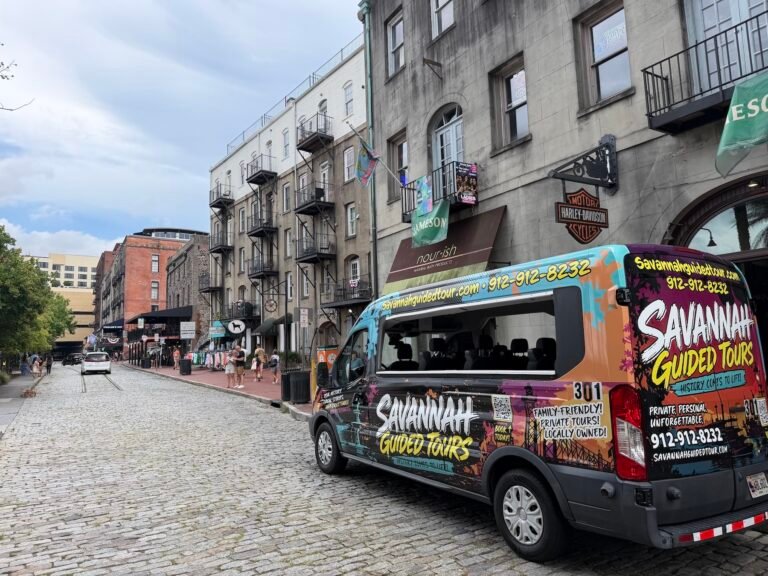
The Savannah Historic District Open-Air Bus Tour runs seven days a week, year-round, with five departures daily from the north edge of Forsyth Park. In summer it is the comfortable way to see the district; in winter it is the fast one. If you would rather take it on foot, the walking tour covers the core squares in two hours and is at its best from October through April.
Check availability for your dates, or get in touch if you are planning around a specific week.
Ready to See Savannah?
Seventy-five minutes, ten landmarks, and a guide who knows which square is which. Small groups fill quickly in spring and autumn — book ahead where you can.