If you have seen one photograph of Savannah, it was almost certainly taken in Forsyth Park. The white cast-iron fountain, the corridor of live oaks hung with Spanish moss, the light coming through in bars. It is the image the city sells itself on, and unlike a lot of tourism photography, it is honest. The park really does look like that.
What the photograph leaves out is everything else. Forsyth Park is thirty acres, and the fountain occupies a very small corner of it. This guide covers the whole thing: the history, what is actually in the park, where to stand for the shot you came for, and the practical details nobody puts on the postcard.
Quick facts
Forsyth Park, Savannah sits at the southern end of the Historic District, bounded by Gaston Street to the north, Park Avenue to the south, Whitaker Street to the west and Drayton Street to the east. It covers roughly 30 acres, is free and open daily, and its cast-iron fountain dates from 1858.
A short history
The land was set aside in the 1840s, when Savannah’s growth had begun to push past the boundaries of General Oglethorpe’s original grid of squares. That grid — wards built around public squares — had governed the city’s shape since 1733. Forsyth Park was something different: not another square, but a single large park in the style then becoming fashionable in Europe and the northern United States.
It was expanded in 1851 and named for John Forsyth, a former Governor of Georgia and U.S. Secretary of State.
The fountain arrived in 1858. It is often said to be modelled on the fountains at the Place de la Concorde in Paris, and the resemblance is real, but its actual origin is more prosaic and more interesting: it was ordered from a catalogue of mass-produced ornamental ironwork. Several closely related fountains from the same era survive in other American cities. Savannah’s is simply the one that ended up in the most photogenic setting.
The park was used as a military parade ground during the Civil War, and the drill field on the southern half is why that portion still feels open where the northern half feels enclosed.
What is actually in the park
The fountain and the north end. The formal, photographed half. A wide central walk runs south from Gaston Street to the fountain, framed by live oaks on both sides.
The oak allée. The double row of live oaks along the central walk. Spanish moss is not a parasite and does not damage the trees, in case you were worried on their behalf. It is an air plant, and it grows here because the humidity supports it.
The Confederate Memorial. Erected in the 1870s in the middle of the park. Its interpretation has been the subject of ongoing public discussion in Savannah, and additional interpretive context has been added over time.
The Fragrant Garden for the Blind. A walled garden opened in the 1960s, planted for scent rather than appearance, with plant labels in Braille. It keeps limited hours and many visitors walk past the wall without realising there is anything behind it.
The Fort. A masonry structure at the southern end, built in the 1900s as a mock fort for militia drills, now housing a café with outdoor seating. The best coffee stop inside the park.
The bandshell and playing fields. The southern half holds tennis courts, basketball courts, a playground, and open lawn used for everything from frisbee to festivals.
The Saturday farmers market. Held at the southern end on Saturday mornings, roughly 9 a.m. to 1 p.m. Produce, baked goods, flowers, prepared food. It is a genuinely local event rather than a tourist one, which is exactly why it is worth an hour.
The best photo spots
1. The central walk, looking south to the fountain
The classic. Stand on the central path a hundred feet or so north of the fountain, get low, and let the oak branches close over the top of the frame. The fountain sits centred at the end of the corridor.
This is the shot everyone wants, which means the path is rarely empty. Early morning is the fix.
2. Close on the fountain, from the northeast
Walk around to the northeastern side of the basin. The tritons and the swans read more clearly from here than from directly in front, and you get the Victorian houses along Drayton Street as a background instead of open sky.
3. The oak allée without the fountain
Turn your back on the fountain and photograph the corridor of oaks alone. Fewer people do this, and the result is often better — a tunnel of trunks, moss and light, with nothing to date the picture.
4. Whitaker and Drayton Street mansion rows
The perimeter streets are lined with Victorian and Italianate houses, several with cast-iron balconies. Late afternoon light on the western side of Drayton is the strongest of the day.
5. The Fort
The masonry fort at the south end is the most overlooked structure in the park and photographs well in flat light, when the fountain does not.
Timing. Aim for the first hour after sunrise if you want the fountain without people, or the last hour before sunset for warm light on the trees. Midday between 11 and 3 gives you hard shadows through the canopy and the largest crowds. If it has rained, come immediately after — the paths reflect and the moss darkens.
Weddings and engagement shoots are constant at the fountain, particularly on spring weekends. If you arrive to find a photographer set up, the oak allée and the Fort are both good alternatives while you wait.
Practical details
Cost: Free. No ticket, no gate.
Hours: Open daily. The park is public space rather than a gated attraction, though the Fragrant Garden and the café keep their own limited hours.
Restrooms: Available near the Fort and café area at the southern end.
Parking: Metered street parking runs along the perimeter on Gaston, Whitaker, Drayton and Park Avenue. It fills by mid-morning on weekends and on any spring Saturday. Rates and enforcement hours are set by the city and change periodically — check the City of Savannah parking pages before you rely on a meter.
Getting there on foot: Forsyth Park is at the southern end of the Historic District, roughly a mile and a half from River Street. That walk is flat but longer than the map suggests, particularly in summer.
How long to allow: Forty-five minutes covers the fountain and the northern half comfortably. Ninety minutes lets you walk the full park including the Fragrant Garden and the Fort. Add an hour if you are coming on a Saturday for the market.
Dogs: Common in the park and generally welcome on lead.
What to combine it with
Forsyth Park sits at one end of the district, which makes it a natural bookend rather than a middle stop.
Walk north from the fountain along Bull Street and you pass through Monterey Square, where the Mercer-Williams House stands, then Madison Square, then Chippewa Square with the Savannah Theatre. That is the single best walk in the city and it takes about twenty-five minutes at a slow pace.
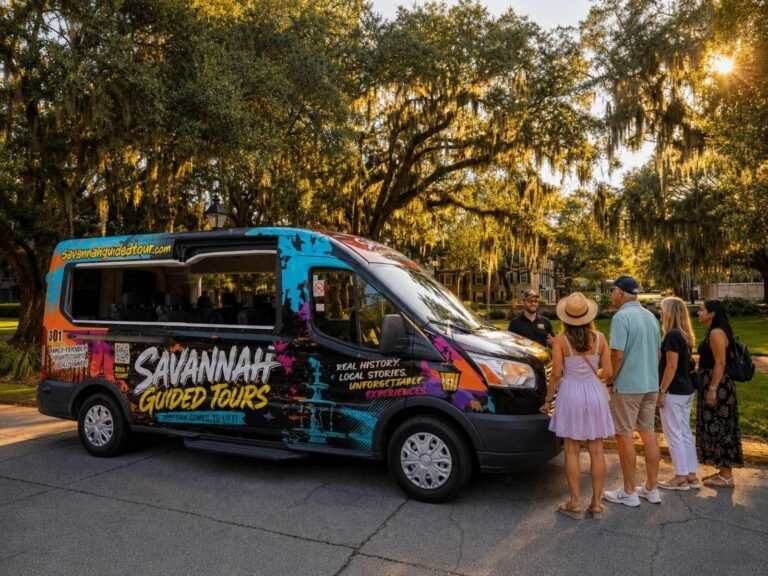
Alternatively, use the park as a starting point. The Savannah Historic District Open-Air Bus Tour departs from 405 E Gaston Street, in the grass lot across from Ganems, directly at the park’s northern edge. Guests routinely photograph the fountain before their departure time and take the tour from there. It is the most efficient combination available in this part of the district.
For visitors who would rather cover the Bull Street squares on foot with a guide, the Savannah Historic District Walking Tour works the same corridor in the opposite direction.
Frequently asked questions
Is Forsyth Park free to visit?
Yes. Forsyth Park is public parkland with no entrance fee, no ticket and no gate. It is open daily. The only paid elements inside the park are the café at the Fort and vendors at the Saturday farmers market.
How old is the Forsyth Park fountain?
The cast-iron fountain was installed in 1858. It was ordered from a commercial catalogue of ornamental ironwork rather than custom designed, and closely related fountains from the same manufacturer survive in several other American cities.
What is the best time of day to photograph Forsyth Park?
The first hour after sunrise gives you the fountain with the fewest people and soft light through the oaks. The hour before sunset gives warmer light on the trees and the perimeter houses. Between 11 a.m. and 3 p.m. the canopy casts hard shadows and the central walk is busiest.
How far is Forsyth Park from River Street?
Roughly a mile and a half, running the full length of the Historic District. The walk is flat and passes through several squares, but takes most visitors thirty to forty minutes each way and is demanding in summer heat.
Is there parking at Forsyth Park?
There is metered street parking along Gaston, Whitaker, Drayton and Park Avenue, but no dedicated lot. Spaces fill by mid-morning at weekends. City garages in the Historic District are a more reliable option for a longer visit.
What is the Spanish moss on the Forsyth Park oaks?
Spanish moss is an epiphyte, an air plant that takes moisture and nutrients from the air rather than from the tree. It is not a parasite and does not harm the live oaks it grows on. Savannah’s humidity is what allows it to thrive.
Start your day where the oaks are
Forsyth Park is the easiest place in Savannah to spend an hour and the hardest place to leave. It is also, conveniently, where the city’s guided tours begin.
The Savannah Historic District Open-Air Bus Tour departs from the park’s northern edge five times a day and covers roughly ten landmarks in 75 minutes — including the fountain you have just photographed, the Cathedral Basilica, Monterey Square and River Street.
Check today’s departures, or contact us if you are planning a private group.
Ready to See Savannah?
Seventy-five minutes, ten landmarks, and a guide who knows which square is which. Small groups fill quickly in spring and autumn — book ahead where you can.